For as long as anyone's been doing wireless, the maths has been brutal. Every radio mic needs its own receiver. Every in-ear needs its own transmitter. Put a decent-sized band or a corporate panel on stage and suddenly you're staring down a full rack of gear, a spaghetti of coax, a wall of antennas, and a frequency coordination job that eats half your setup time. It works — it's just heavy, fiddly, and slow.
Sennheiser Spectera throws all of that out. It's the world's first wideband, bidirectional digital wireless ecosystem, and it does something no system has done before: it runs your entire production — mics and in-ears — through a single wideband RF channel and a single beltpack per person. One box, one channel, and the rack disappears.
How it pulls that off
The clever bit is a new technology called WMAS — Wireless Multichannel Audio Systems. Instead of chewing up a narrow slice of spectrum for every single link, Spectera drops the whole show onto one 6 or 8 MHz wideband carrier. Mic feeds and IEM mixes live in the same bandwidth at the same time, which is the thing that's never been possible until now. And because it's wideband, it shrugs off the RF fading and dropouts that plague traditional narrowband gear — Sennheiser reckons on the order of 40x diversity on an 8 MHz carrier. It's built to not fall over.
The three pieces
The whole system comes down to three bits of hardware.
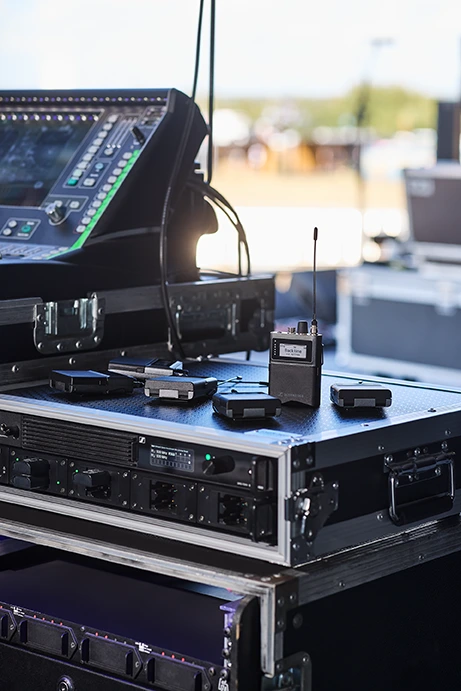
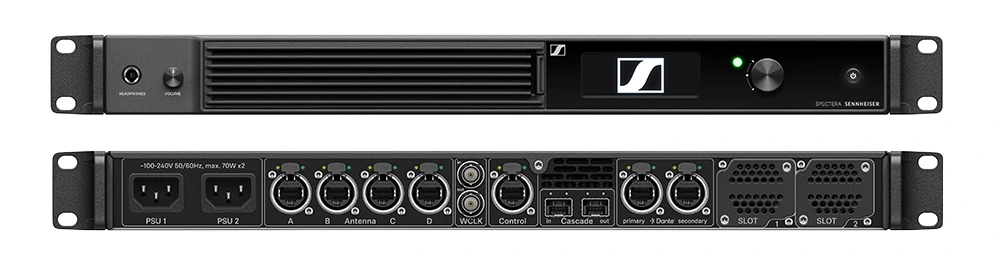
The Base Station is the heart of it — a single 1U rack unit doing 32 in and 32 out, up to 64 channels, that quite literally replaces an entire rack of separate receivers and IEM transmitters. It's built for jobs that can't fail: dual power supplies, redundant primary and secondary Dante, MADI options, wordclock, and four antenna ports that run power out over the cable.
The SEK bodypack is where the magic really shows. It's a dual-purpose pack — a mic/line transmitter and an in-ear receiver in the same body, running both at once. So the one thing clipped to the talent's belt is doing the job that used to take two separate packs. It runs on a rechargeable BA 70 battery good for around seven hours, and it comes in UHF and 1.4 GHz versions.
The DAD antennas are "transceiving" — they transmit and receive in the one unit, handling IEM signals, mic signals and control data all together. They connect back to the base station over ordinary CAT5e with power down the same cable, in 10, 25 or 50 metre runs, and they've got the RF components built in — so no combiners, no splitters, no boosters, no antenna rack. They're IP54 rated too, so a bit of weather won't scare them.
The whole lot is driven from Sennheiser's LinkDesk software on a Mac or PC.
Why your monitor engineer will love you
Because the link is bidirectional, the base station is talking to every pack the whole time — not just firing audio at it. That means your engineer can see and control everything from front of house or the monitor world: IEM volume, audio levels, RF health, battery status, link quality, the lot. No more sending someone side-of-stage to swap a pack blind. On top of that you get proper Sennheiser audio — 24-bit/96 kHz, uncompressed — and eleven selectable link modes so you can trade channel count against latency and range to suit the gig.
And the latency is the quiet showstopper. Performers on in-ears are brutally sensitive to delay — even a few milliseconds between playing a note and hearing it in your ears throws your timing and makes you push flat. Spectera runs IEMs down to 0.7 ms, with mic and line signals around 1 ms. That's low enough that the wireless simply stops being something the artist notices — it feels like a wired monitor, but without the cable tethering them to one spot. For singers, drummers and anyone living in their in-ears all night, that's the difference between tolerating the rig and forgetting it's there.
And it all lives on Dante. Every channel comes off the base station straight onto your Dante network — redundant primary and secondary feeds for safety — so there's no analog splitting, no extra converters, no separate audio rack. The whole show just sits on the network, ready to patch into your console, your stageboxes, your broadcast or recording feed, whatever you're running. For a production that's already built on Dante, Spectera drops in as one more device on the network — which is about as clean as a wireless handoff gets. And if a job calls for it, the base station takes optional MADI cards as well, so you can hand audio off however the rig in front of you is built — Dante for most, MADI when that's what the console or broadcast truck wants.
The upshot for a production: massive channel counts in a fraction of the footprint, dramatically less cable and RF gear, faster load-ins and load-outs, and a system that holds together when the room's packed and the spectrum's a warzone. Festivals, touring, theatre, broadcast, big corporate — this is exactly the gear those jobs have been waiting for.
Available for hire now — and we've got the deepest stock in SEQ
Here's the part that matters if you've got a show coming up: Captivate AV has Spectera on the shelf, ready to hire.
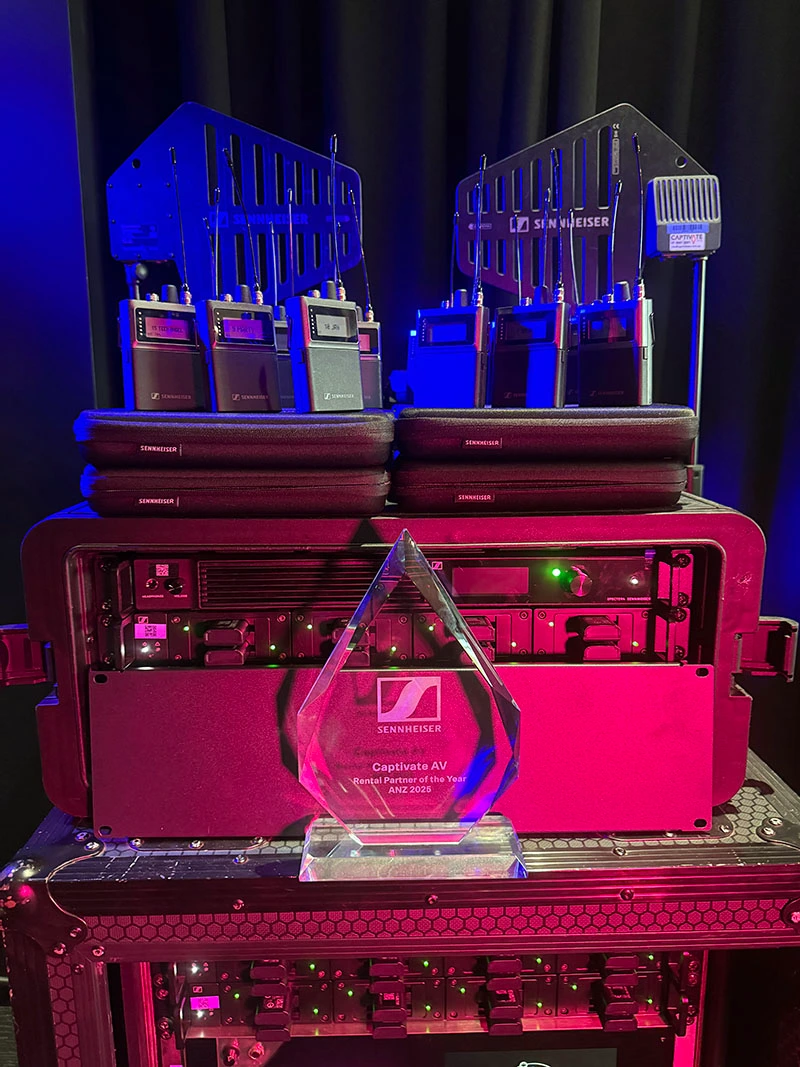
We're carrying two complete kits, four antennas and 22 SEK beltpacks, with microphones on order and landing the moment Sennheiser can ship them. That's the largest Spectera stock in South East Queensland — enough to put a serious production on air without waiting on anyone.
And we didn't just buy it and hope. Sennheiser named Captivate AV their Rental Partner of the Year — so when you hire it from us, you're getting it from the crew Sennheiser themselves back to deploy and support it properly.
If you want to see it — or hear it — before you book, get in touch and we'll set up a demo. Once you've run mics and in-ears off a single pack, you won't want to rack up the old way again.
Captivate AV — live events, integration and hire, Gold Coast and Brisbane.